



My Neighbour Totoro
Student: Asal Kavianifar
My Neighbour Totoro, written and directed by Hayao Miyazaki, is set in post-war rural Japan during the 1950s. The story follows two sisters, Satsuki and Mei, who move with their father to the countryside while their mother is hospitalized.
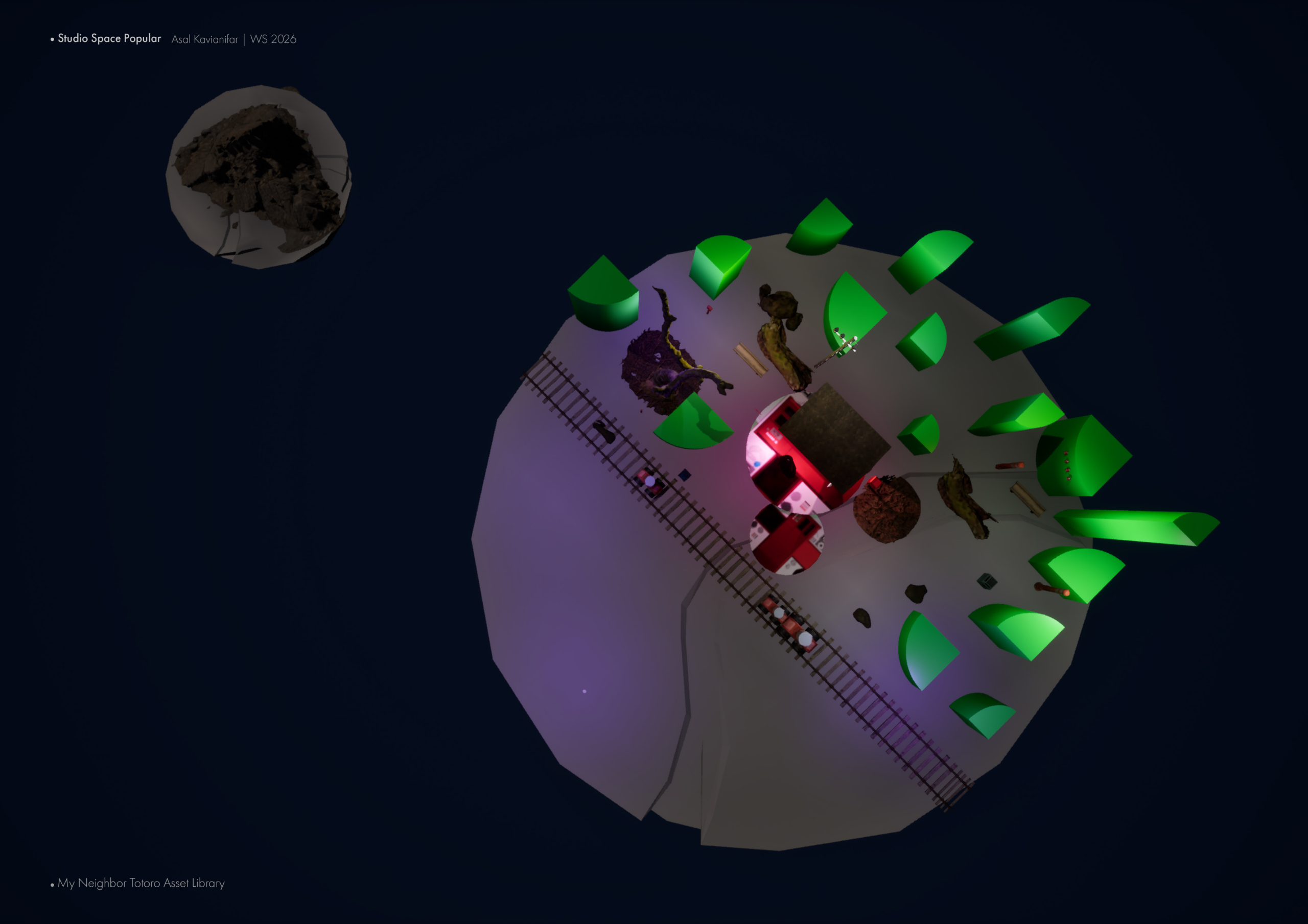
What drew me to this story is the way it moves sequentially through different emotional states: curiosity, fear, discovery, magic. I translated this progression into a series of islands, where each island holds one key moment of the story. This allowed me to spatialise the narrative and create distinct, self-contained worlds that still remain connected.
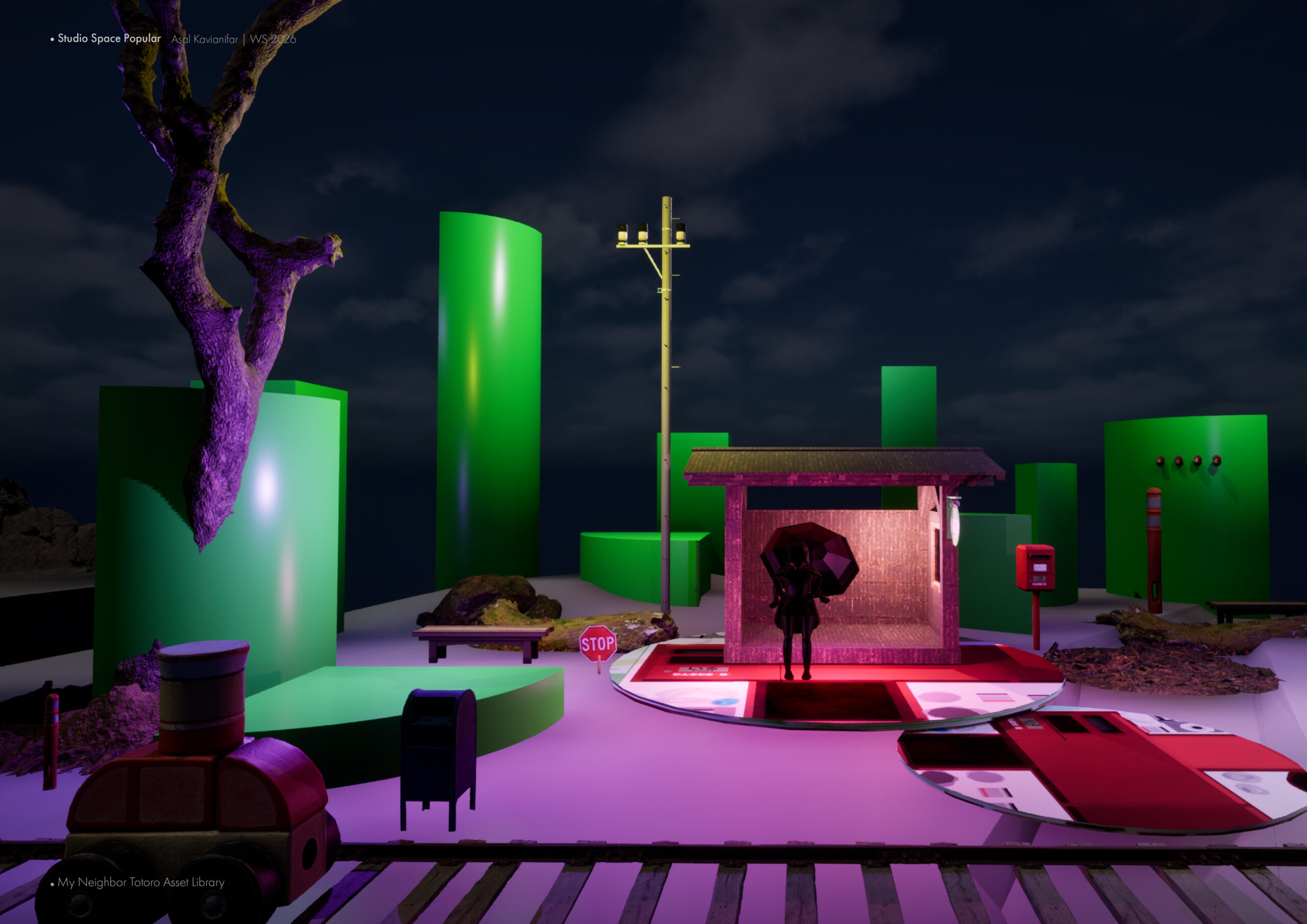
Each worldviews is conceived as a hybrid: part real, part magical. Realistic elements such as the house and pathways anchor the narrative in everyday life. The magical encounters with Totoro happen in environments where the natural elements shift.
Overall, the project synthesises a contrast between realism and fantasy. It recreates the emotional transitions of Totoro through crafted environments that quietly shift between the ordinary and the magical.
The first stage represents the interior of the house. The audience views the performance through a very narrow opening, reinforcing the idea of watching a world from the inside out.
The floor plan of the scene is printed on the ground, so people can see the traces of movement—footsteps, objects—almost like a living pattern book. This level establishes a grounded, domestic atmosphere.”
On the upper level, the audience moves outside the house. The transition from the enclosed opening to a more open exterior space expands their visual field and shifts the tone from intimate to observational. This level sets the stage for encountering nature.
The third level immerses the audience in the forest environment. A ring of physical elements surrounds them—trees, plants, and fragments of the magical world. The magical moments of the story are revealed through another narrow opening, echoing the logic of worldviews from Phase 1: reality is present, but magic leaks into it subtly and unexpectedly. The idea is that magic is never fully exposed—it is always partially hidden.”
Beyond the physical visitors, there is an extended layer of virtual audience. They can join the performance in two ways:
1. Live streaming from four virtual viewpoints, matching the four key worldviews.
2. Participation inside the virtual world, entering through a digital lobby and moving into the
This allows the world to be experienced at multiple scales and modes simultaneously.”