Mohammad Sajad Ghaderi
Urban Imaginaries
Thesis Project Summer Term 26
The future is built through images long before it is built through architecture. Today, generative artificial intelligence is transforming who can create those images, democratizing the production of urban futures and expanding the range of voices that participate in imagining tomorrow. Yet despite this shift, the visual language of the future remains remarkably narrow. Across science fiction, cinema, and popular media, future cities are repeatedly represented through the same set of aesthetic conventions: vertical megastructures, layered infrastructures, technological spectacle, and increasingly homogenized urban identities. Within these imaginaries, visions of the Persian city are largely absent.
Urban Imaginaries investigates how generative AI can be used to construct alternative futures for the Central Persian Plateau while critically engaging with the visual conventions inherited from Western popular culture. Rather than asking what a Persian future city should look like, the project examines how such futures can be imagined without reproducing existing stereotypes of either “the future” or “Persian architecture.”
The research begins by tracing the origins of contemporary urban imaginaries through science fiction, Orientalism, architectural history, and AI image generation. By testing and analyzing the biases embedded within generative models, the project reveals how AI often reproduces familiar cultural assumptions, generating futures that are little more than contemporary cities decorated with historical motifs.
To move beyond these limitations, a design methodology was developed based on the creation of custom visual asset libraries derived from the architecture, landscapes, and cultural artifacts of the Central Persian Plateau. Architectural fragments, spatial typologies, vernacular technologies, Persian miniatures, and emerging environmental systems were collected, extracted, and recombined through iterative AI workflows. These were supplemented by unfamiliar formal references to encourage novel spatial and architectural outcomes.
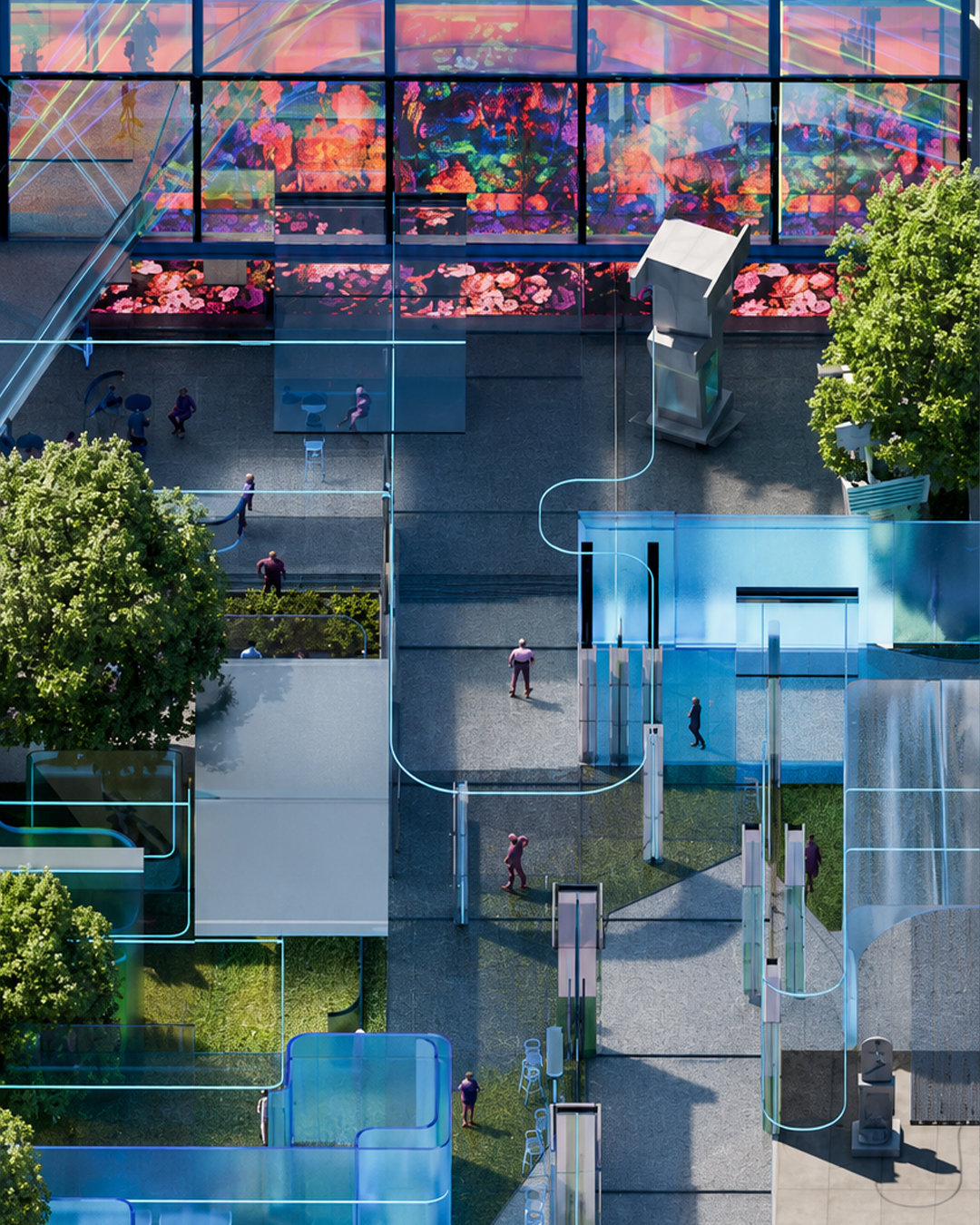
The resulting images are not proposals for a definitive Persian future. Instead, they constitute a speculative methodology for generating urban imaginaries that are simultaneously rooted in local cultural contexts and open to technological transformation. Urban Imaginaries proposes a framework for using AI not as a tool for reproducing inherited visions of the future, but as a medium for expanding them.